MUSEVENI SWORN IN FOR SEVENTH TERM AS KISWAHILI REMAINS DOMINANT IN UGANDA’S MILITARY
By Jack Gor
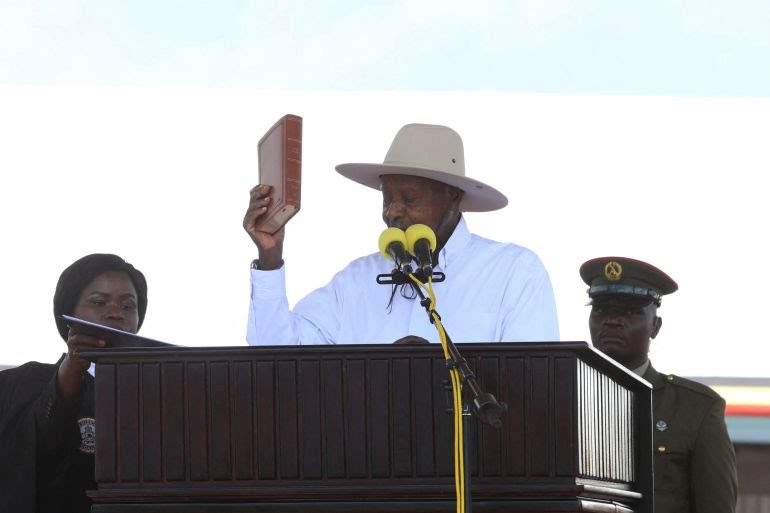
Uganda’s President Yoweri Museveni has been sworn in for a seventh term, extending his rule to 2031 after first taking power in 1986.
Heads of state and foreign dignitaries began arriving in Kampala over the weekend ahead of Monday’s inauguration, with rehearsal images from the ceremony circulating widely on social media. The Electoral Commission declared Museveni winner with 71 percent of the vote against opposition candidate Robert Kyagulanyi, the musician-turned-politician popularly known as Bobi Wine. This marks the second consecutive presidential election in which the 80-year-old Museveni has faced Kyagulanyi.
Noticeably absent was Kizza Besigye, Museveni’s former comrade and personal physician during the 1986 bush war that brought the National Resistance Movement to power. Besigye, now a fierce critic of the president, remains in prison after falling out with Museveni over the country’s governance.
Uganda’s political history has been turbulent, marked by conflicts that nearly crippled the nation. The Nairobi Accord, hosted by Kenya’s former President Daniel Arap Moi and other regional stakeholders, sought to end hostilities but yielded little progress. Since independence, Uganda has been led by several presidents, including Edward Mutesa II, Milton Obote, Idi Amin, Yusuf Lule, Godfrey Binaisa, Paulo Muwanga, and Tito Okello before Museveni took power.
The Uganda People’s Defence Forces have evolved significantly since the era of kadogo child soldiers, who were recruited to help oust Idi Amin and later Milton Obote.
One striking feature of today’s military is its use of Kiswahili, despite English being Uganda’s official language. Many Ugandans distance themselves from Kiswahili, viewing it as a language of the army rather than for civilians.
The roots of Kiswahili in the UPDF trace back to Museveni’s close ties with Tanzania’s founding President Julius Nyerere. Nyerere’s army was instrumental in the 1979 war that toppled Idi Amin and later supported Museveni’s bush war. Tanzania’s military operates in Kiswahili, and that influence carried into Uganda’s forces after 1986.
The language was on display during Monday’s inauguration parade when a military commander sought permission from the commander-in-chief in Kiswahili, stating: “Naomba ruhusa rais kuondoa bendera uwanjani” — “I request your permission, Your Excellency, to remove the flag from the parade ground.”
Museveni has suggested this will be his final term. By 2031, he will have led Uganda for nearly 47 years, making him one of the longest-serving non-royal heads of state globally. With his son Muhoozi Kainerugaba positioning himself as a potential successor, Kiswahili’s prominence in the military is unlikely to fade soon.
Jack Gor is a U.S.-based journalist who has worked with local and international media houses. He holds a diploma in mass communication and a bachelor’s degree in theology.