Johns Hopkins Makes History with First All-Black Trauma Team
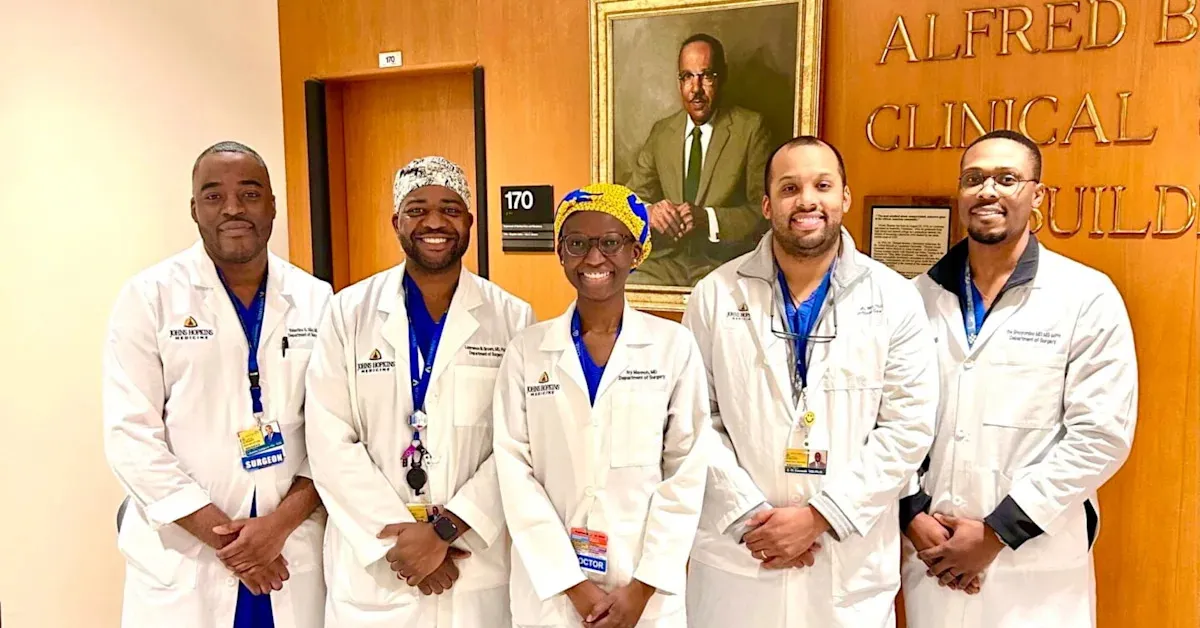
A historic milestone has been achieved at Johns Hopkins University in Baltimore with the formation of its first-ever all-Black trauma and acute care surgery team. This groundbreaking development marks a significant moment for the field of medicine, where Black surgeons remain underrepresented. The team, composed of five residents and fellows, is leading the trauma and acute care surgery efforts at the prestigious hospital.
The team includes Valentine S. Alia, M.D., a second-year resident, Ivy Mannoh, M.D., a third-year resident, Ifeoluwa ‘Ife’ Shoyombo, M.D., M.P.H., M.S., also a third-year resident, Lawrence B. Brown, M.D., Ph.D., M.P.H., a seventh-year resident, and Zachary Obinna Enumah, M.D., Ph.D., M.A., a ninth-year and critical care fellow. Among them, Dr. Mannoh is the sole woman, highlighting the team’s diversity.
This development is notable as it reflects broader conversations about representation within the medical field. According to recent statistics, only 5.6% of surgeons in training are Black, a stark contrast to the 13.4% Black population in the United States. This new team at Johns Hopkins serves as a beacon of progress and inspiration in a field striving for greater equity and inclusion.
Dr. Lawrence B. Brown expressed personal pride in being part of this historic team. As the first physician in his family, he emphasized the importance of equity in healthcare. ‘Medicine is not just science, it’s also service,’ Dr. Brown stated. ‘Equity must remain at the forefront of how we deliver patient care, conduct research, and scale programs within our healthcare system.’
For Dr. Zachary Obinna Enumah, the path to joining this historic team was influenced by his upbringing. Raised in Columbus, Georgia, during the 1990s, Dr. Enumah was inspired by the dedication of his parents, both medical professionals. His mother practiced family medicine, while his father was a general surgeon. ‘I watched my parents show up to serve patients every day,’ Dr. Enumah recounted, indicating that their commitment to healthcare played a crucial role in his own career choice.
This achievement at Johns Hopkins comes amidst broader societal challenges, particularly for Black workers in the United States. Reports indicate that Black workers, especially Black women, have faced increasing challenges in the workforce. This all-Black trauma team stands as a testament to resilience and progress in the face of adversity.
Johns Hopkins Hospital, renowned for its medical advancements and educational excellence, continues to be a leader in fostering a diverse and inclusive environment. The formation of this team is a reflection of the institution’s commitment to breaking barriers and setting new standards in the medical community.
The significance of this team extends beyond the walls of Johns Hopkins. It serves as a symbol of hope and possibility for aspiring Black medical professionals across the country. As the team continues to lead in trauma care, their work will likely inspire future generations to pursue careers in medicine, contributing to a more equitable and diverse healthcare landscape.
This development underscores the ongoing need for increased representation and diversity in the medical field. The all-Black trauma team at Johns Hopkins is not only a historic first but also a step toward addressing the disparities that exist within the healthcare system.