Wangari Maathai: The Roots of Resistance:The Woman Who Stopped a President’s Monument
How Trees Toppled a Dictator’s Vision
It was planned for Uhuru Park—the only public green space in Nairobi where anyone could relax without paying. Around it would rise a 60-storey complex with party offices, shops, and parking.
One woman brought the entire project to a halt. Wangari Maathai.
She was born in 1940 in Ihithe village, Nyeri, Kenya.
At the time, girls there were rarely sent to school. It was her older brother who asked their parents why she should stay home. No one had a convincing answer, so they enrolled her.
In 1960 she became one of roughly 300 Kenyan students flown to the United States through the Kennedy Airlift program.
She studied biology in Kansas, earned a master’s degree in Pittsburgh, and eventually returned home.
In 1971 she completed her doctorate at the University of Nairobi, becoming the first woman in East and Central Africa to earn a PhD. She later became the university’s first female professor.
Then she started visiting rural communities and listening.
Women spoke about rivers disappearing. Firewood becoming scarce. Children going hungry.
Forests had been cleared to expand tea and coffee plantations, and the people living there had never been consulted.
Her solution sounded almost unbelievably simple.
Plant trees.
June 1977. Kamukunji Park, Nairobi.
She planted seven seedlings. Most of them failed.
Forestry officials insisted only trained experts could raise healthy seedlings. She ignored them and taught village women instead.
Then she paid them—not for planting, but for keeping the trees alive months later.
The idea spread from backyard nurseries to entire communities.
Eventually more than 30,000 women participated, helping grow over 51 million trees.
Her husband served as a member of parliament.
In 1979 he filed for divorce.
He argued she was too educated, too independent, too accomplished, too stubborn, and impossible to control. The court sided with him.
After she publicly criticized the judge as incompetent or corrupt, she was sentenced to six months for contempt, serving three days.
Her former husband demanded she stop using his surname.
She added another “a” instead.
Mathai became Maathai.
In 1989 President Daniel arap Moi’s government unveiled plans for the tower.
She wrote to ministers, the United Nations, and the British High Commissioner.
Her legal challenge failed.
Moi mocked opponents, saying they had insects in their heads.
On Independence Day, speaking in the same park, he told her to behave like a proper African woman—to respect men and remain silent.
Members of parliament laughed.
The government evicted her from her office.
She continued leading the campaign from her living room.
Foreign investors saw the international coverage.
By January 1990 they withdrew.
The development collapsed.
February 28, 1992.
She joined the mothers of 52 political prisoners in a hunger strike at what became known as Freedom Corner, directly across from the Nyayo House torture chambers.
On March 3 police charged the protest.
She was beaten unconscious and later woke up in hospital.
The elderly mothers resorted to their final act of resistance.
They stripped naked before the officers.
Within Kikuyu tradition it carried the weight of a powerful curse.
The police retreated.
Moi called her a madwoman and a danger to national security.
The women relocated to a cathedral crypt, remaining there for nearly 11 months.
By January 1993 their imprisoned sons had been released.
In 1991 she received the Goldman Environmental Prize in San Francisco.
CNN devoted several minutes to the story.
When the broadcast aired in Kenya, that portion had been removed.
In 1998 Karura Forest, just outside Nairobi, was being divided into plots for politically connected developers.
January 8, 1999.
She entered the forest to plant a tree where a golf course had been proposed.
Armed men waited at the entrance with clubs and machetes.
They struck her in the head.
Journalists and members of parliament were attacked alongside her.
Television cameras captured everything.
Students protested for months.
The United Nations voiced concern.
On August 16, 1999, Moi announced an immediate ban on allocating public land.
In 2002 his party finally lost power after four decades.
Wangari Maathai won her parliamentary seat with 98 percent of the vote.
October 2004.
A call arrived from Oslo.
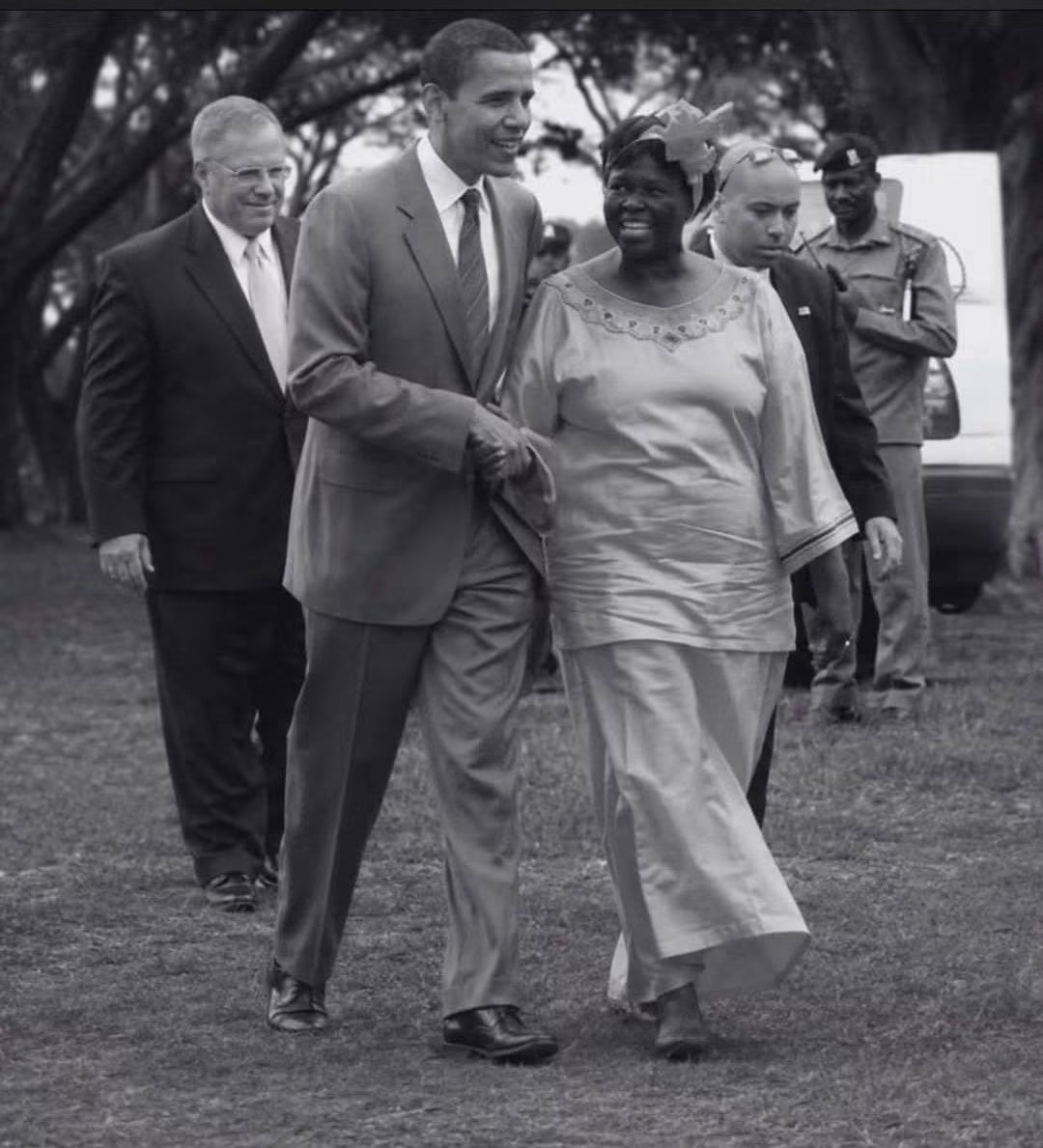
She had been awarded the Nobel Peace Prize—the first African woman and the first environmental activist ever to receive it.
Only 13 years earlier, her own country had erased her award from a television broadcast.
Now the Nobel Committee was recognizing her work as a foundation for peace.
She stepped outside her home and planted another tree.
She died on September 25, 2011, from ovarian cancer at the age of 71.
She left one final request.
No wood.
Her coffin was made from bamboo, papyrus, and water hyacinth.
Not a single tree was cut down for her funeral.
March 2026.
Three Nobel Peace Prize laureates gathered in Karura Forest, where she had once been beaten, and planted new saplings.
Among them stood her daughter, Wanjira Maathai, now chair of her mother’s foundation.
Then came June 2026.
The Green Belt Movement discovered survey markers inside Uhuru Park.
Pegs driven into the ground.
Plans linked to a highway expansion.
County officials insisted the park would remain untouched.
The movement she founded promised to challenge the project in court.
A month later it warned that Kenya’s remaining old-growth forests continued disappearing to roads, stadiums, and luxury developments.
National forest cover had remained unchanged for four years at 8.83 percent—still below the constitutional target of 10 percent.
She often ended her speeches with the same story.
A forest is burning.
Every animal watches from a distance.
Only a hummingbird keeps flying back and forth carrying tiny drops of water.
The elephant asks what difference that could possibly make.
The hummingbird answers:
“I am doing the best I can.”
Uhuru Park still stands.
Still open.
Still free.
There is no tower.
There is no giant statue.