Ruto’s Tanga Gamble: Oil, Power, and the Ghost of East Africa’s Broken Union
Why Ruto Took Kenya’s Oil Dream to Tanzania
WHY PRESIDENT RUTO TOOK CRUDE OIL REFINERY TO TANZANIA
By Jack Gor, USA journalist
NAIROBI/DAR ES SALAAM President William Ruto’s decision to back a multibillion-dollar crude oil refinery in Tanga, Tanzania, is not just about energy security. It is a deliberate political gambit to dismantle decades of mistrust that have haunted East Africa since the collapse of the first East African Community in 1977.
Two weeks ago in Nairobi, Ruto and Uganda’s President Yoweri Museveni jointly announced plans for the Tanga facility, designed to cut the region’s dependence on refined fuel imports. The move startled Tanzania’s Parliament, where lawmakers pressed President Samia Suluhu Hassan to explain the project’s origins after it emerged Kenya and Uganda had unveiled it without Dar es Salaam’s public sign-off.
But for Ruto, the refinery is the latest attempt to exorcise the ghost of 1977 and to test whether economic interdependence can succeed where the founding fathers failed.
The Dream That Died Before the Ink Dried
The ambition for East African unity was seeded by Jomo Kenyatta of Kenya, Milton Obote of Uganda, and Julius Nyerere of Tanzania. The three envisioned a federation that would bind the region economically, socially, and ideologically after independence.
That dream was formalized in the 1965 Kampala Accord, which sought to correct trade imbalances within the East African Common Market. Under the accord, Kenya agreed to restrict certain exports to Tanzania and Uganda to protect their infant industries, while the two neighbors were allowed to impose limited tariffs on Kenyan goods. The accord was revised and reaffirmed in 1966, but implementation stalled.
Ideological rifts soon choked the union. Kenya pursued free-market capitalism. Tanzania, under Nyerere’s Ujamaa, chose African socialism. Uganda wavered, then plunged into chaos when Obote was overthrown by Idi Amin in 1971. Amin publicly dismissed the federation project, focusing instead on regime survival. His erratic policies and Nyerere’s refusal to sit with him created a leadership vacuum. By 1977, the EAC collapsed.
The fallout was bitter. Kenya retained key community infrastructure headquartered in Nairobi, including assets of the former East African Airways and Railways. Tanzania viewed the outcome as betrayal. Borders closed. Trade barriers rose. Citizens who shared culture, language, and kinship Maasai, Luo, Teso, Kuria, Kalenjin, and others straddling national lines paid the price as movement and commerce grew harder.
A Curse of Mistrust
Since then, successive governments have struggled to rebuild trust. Ruto is not the first Kenyan president to address Tanzania’s Parliament. His political mentor, Daniel arap Moi, did so in 2002. “We cannot grow together if we shall see each other as enemies,” Moi told lawmakers, exposing a reality: beneath diplomatic handshakes lay deep suspicion.
Ruto’s calculation is that megaprojects can succeed where speeches failed. By placing the refinery in Tanga, he ties Tanzania’s industrial future to Kenya’s energy corridor and Uganda’s crude exports. Kenya has already opened its pipeline infrastructure to Uganda through share offers in the Kenya Pipeline Company. With the Tanga plan, the three original EAC states become economically interlocked “more than conjoined twins,” as one Nairobi analyst put it.
Reviving the Wildebeest Principle
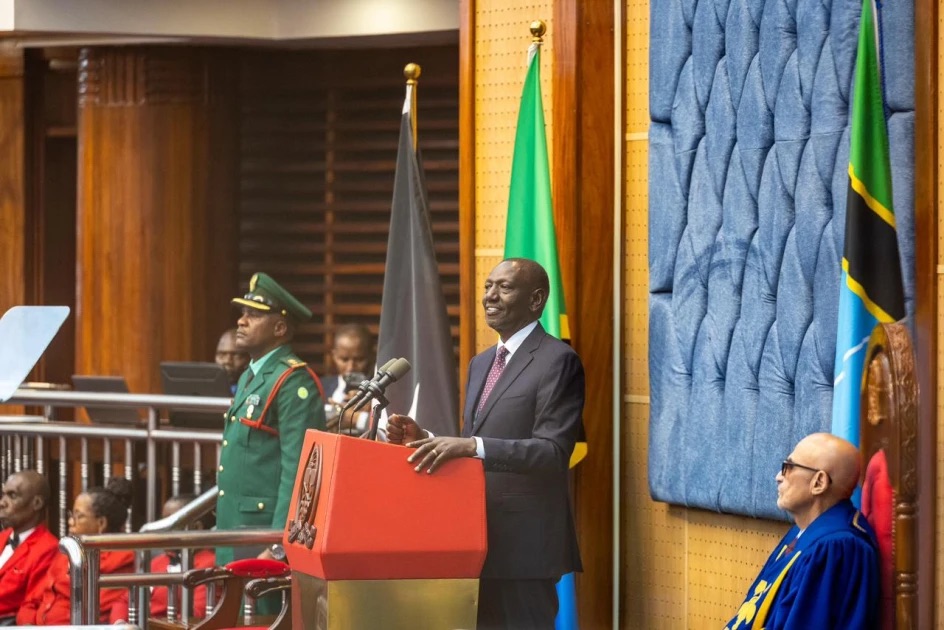
Addressing Tanzania’s Parliament, Ruto warned that today’s leaders will own the same failures as the founding fathers if they repeat old mistakes. “We should not become victims of limiting forces,” he said.
He borrowed a metaphor Samia first used in Kenya’s Parliament: the wildebeest migration. Each year, millions of animals cross the Mara-Serengeti ecosystem freely, fueling a tourism economy worth billions. “What nature has given should not be broken by unwanted policies,” Ruto told Dodoma. If wildlife can integrate across borders, he argued, so can economies.
A Federation Under Strain
The stakes are higher now. The revived EAC, relaunched in 2000, has grown from three to eight members: Kenya, Uganda, Tanzania, Rwanda, Burundi, South Sudan, Somalia, and the Democratic Republic of Congo. The DRC remains “half-footed” in the bloc amid border tensions with Rwanda.
Integration remains uneven. Non-tariff barriers persist. Suspicion still surfaces when one state appears to dominate. The Tanga refinery will test whether joint ownership of strategic assets can rewrite that script.
For Tanzania, the project offers industrialization and port revenues. For Kenya and Uganda, it promises cheaper fuel and reduced import bills. For the region, it is a trial of political will.
As Ruto put it in Dodoma: the failures of 1977 need not be the inheritance of 2026. What remains is to see whether East Africa’s leaders and their citizens will behave like the wildebeest, or like the men who let the first federation die before the ink dried.