Ruto Unveils Raila Odinga Mausoleum in Bondo Ahead of First Anniversary
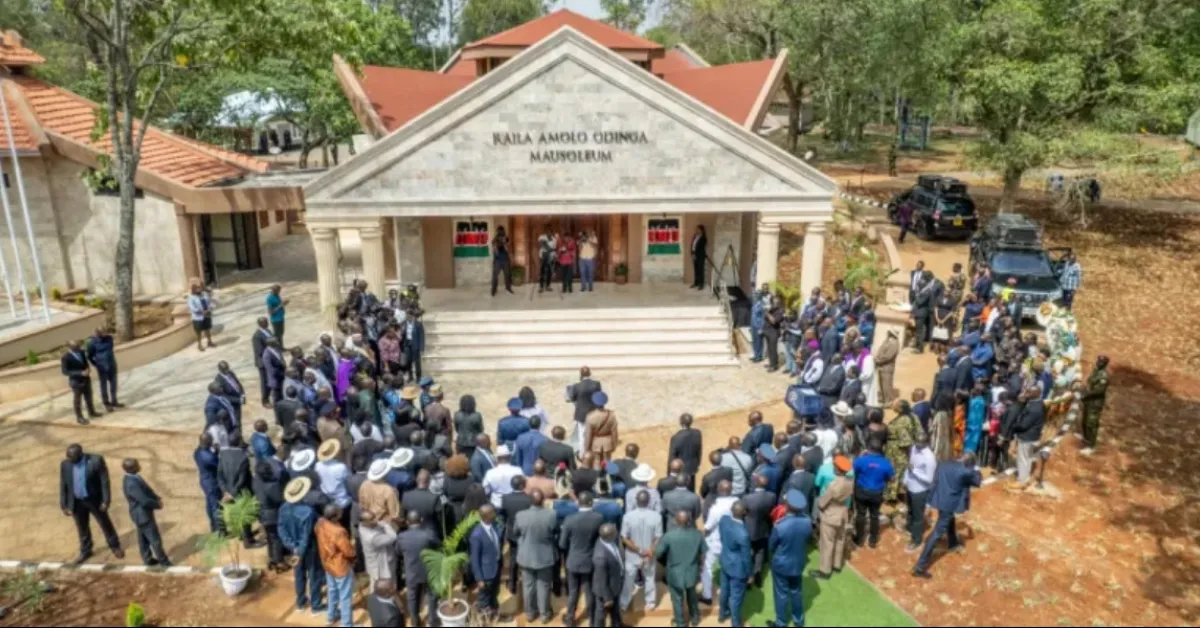
President William Ruto has unveiled and dedicated the mausoleum of former Prime Minister Raila Amolo Odinga at Kang’o Ka Jaramogi in Bondo, with leaders using the ceremony to reflect on his contribution to Kenya’s democratic and political development.
Speaking during the ceremony in Siaya County, Ruto said the design of the mausoleum was intended to reflect values associated with Raila’s political career. He said its five-sided structure symbolised unity, collective purpose and completeness, while also recalling the ODM Pentagon alliance formed before the 2007 General Election.
Ruto, who was part of the alliance, said the period showed Raila’s ability to build political partnerships across ethnic and regional divisions. He described the pentagonal design as a reminder of an effort to bring different parts of the country together around a shared political agenda.
The mausoleum stands next to the resting place of Raila’s father, Kenya’s first Vice-President, Jaramogi Oginga Odinga. Ruto noted that Jaramogi’s mausoleum has a six-sided design, describing the two structures as symbols of two generations whose political careers took place in different periods but were linked by a commitment to national transformation.
Ruto said Raila’s legacy should not be measured by the monument alone, arguing that lasting political legacies are reflected in policies and improvements in people’s lives. He said Raila consistently advocated equitable development and opposed discrimination based on geography, ethnicity or political affiliation.
The President linked this approach to several government infrastructure projects, including major road developments, the planned extension of the Standard Gauge Railway to western Kenya and other regional connectivity programmes. He described the projects as part of efforts to address long-standing inequalities between different parts of the country.
Nairobi Governor Johnson Sakaja also paid tribute to Raila, describing him as both a major national political figure and a mentor who had influenced his leadership.
Sakaja said Kenyans had spent the past year mourning Raila but should now focus on preserving the values he represented. He recognised Raila’s role as a reformist, democracy advocate and former Prime Minister, while also describing him as a father figure in his personal life.
He said Raila taught him the importance of conviction and the courage to pursue difficult causes before they became widely accepted. Sakaja also praised his ability to maintain personal relationships despite political disagreements, saying this was an important part of his leadership style.
Sakaja said Raila’s contribution should be measured through Kenya’s democratic development, the expansion of political freedoms and the younger leaders who were influenced by his example. He said the lessons Raila passed on through personal mentorship were as important as his public achievements.
Siaya Senator Oburu Odinga also reflected on his brother’s legacy in a message delivered by his son, Jaoko Oburu, as the senator continues to recover after receiving medical treatment in Nairobi. Oburu described the mausoleum as more than a burial site, saying it should serve as a national civic landmark representing constitutionalism, freedom and social justice.
He said future generations could use the monument as a reminder of the sacrifices made during Kenya’s democratic struggle and the importance of national unity. He placed Raila’s political career within the wider history of the Odinga family, saying both Raila and Jaramogi had worked to expand democratic space and strengthen national institutions.
Oburu also defended Raila’s decision to work with the Kenya Kwanza administration during the final years of his life. He described the cooperation as part of a broader Odinga family commitment to national unity and stability rather than political division.
He said the broad-based political arrangement had helped create a more stable environment for governance and supported the implementation of national development programmes. The commissioning of the mausoleum comes ahead of the first anniversary of Raila’s death on 15 October and forms part of the wider Mwezi wa Baba commemorations.
The facility is expected to open to visitors immediately, while a major public memorial service is scheduled for next week. The ceremony also placed renewed focus on how Raila’s legacy will be carried forward. His supporters continue to associate his political career with democratic reform, constitutional change and greater political inclusion, while leaders in government are increasingly linking his legacy to current efforts on national unity, development and governance.