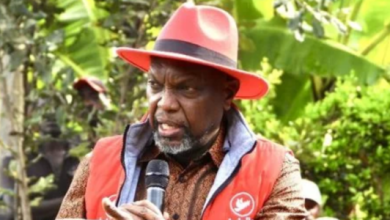
Court Told DNA Test Establishes Njage as Son of Late Former VP George Saitoti in Estate Battle

A court in Nairobi, Kenya, has been told that a DNA test has established a man identified as Njage as the son of the late former Vice President George Saitoti, whose estate has been at the centre of a long-running succession dispute. The DNA results were revealed in court by a brother of the former vice president, Kenyan newspapers the Daily Nation and The Star reported.
Njage has been laying claim to a share of the estate of the former vice president, who died in June 2012. The claim has been contested within the family, and proof of paternity has stood as the central question in the dispute over the estate of the late politician.
According to The Star, the court was told that the DNA test establishes Njage as Saitoti’s son. The Daily Nation reported that the brother of the former vice president revealed the DNA results of the man claiming a share of the estate during the proceedings.
George Saitoti was one of the most prominent figures in Kenyan politics for more than two decades. A mathematics professor who taught at the University of Nairobi, he joined the government as a minister in the 1980s before his elevation to the vice presidency. He served as Kenya’s Vice President in two spells under President Daniel arap Moi, first from 1989 to 1997 and again from 1999 to 2002, a combined thirteen years that made him the country’s longest-serving holder of the office.
In 2002, Saitoti sought the presidential nomination of the ruling Kenya African National Union but lost to Uhuru Kenyatta at a delegates’ conference in Nairobi. He later served as Minister for Education in the government of President Mwai Kibaki before returning to senior positions in cabinet.
At the time of his death, Saitoti was the Member of Parliament for Kajiado North and held the Internal Security and Provincial Administration docket. On June 10, 2012, he was killed alongside Internal Security Assistant Minister Orwa Ojode, two pilots and two police officers when a police helicopter crashed in the Kibiku area of Ngong, Kajiado County, shortly after taking off from Nairobi’s Wilson Airport. All six people on board died.
The crash prompted the appointment of a judicial commission of inquiry to investigate the circumstances of the accident. Saitoti’s death cut short a career in which he had publicly signalled an intention to contest the presidency in the 2013 general election while serving in the Internal Security docket.
The former vice president was survived by his widow, Margaret Saitoti, and the couple raised an adopted daughter, Kenyan media reported at the time of his death. Saitoti had no publicly known biological children, and Njage’s assertion that he was the late politician’s son placed the question of paternity at the heart of the estate proceedings.
Succession proceedings over the estate were lodged following the former vice president’s death, and the question of who qualifies as a beneficiary has since been before the court. Under Kenya’s Law of Succession Act, a child of a deceased person ranks among those entitled to a share of an estate, and claims of parentage are determined on the evidence placed before the court.
Because Saitoti died in 2012, the DNA evidence now before the court has emerged years into the dispute. Members of the Saitoti family and Njage have been involved in the proceedings as the claim over the estate has made its way through the justice system.
The matter now rests with the court, which will weigh the DNA results alongside other material filed in the succession cause in determining Njage’s claim to a share of the estate of the late former vice president.