186+ Websites Hit by OPTIMJACK: What CNN, BBC and Zoom Visitors Must Know Now
By Samrack Media Team | November 16, 2026
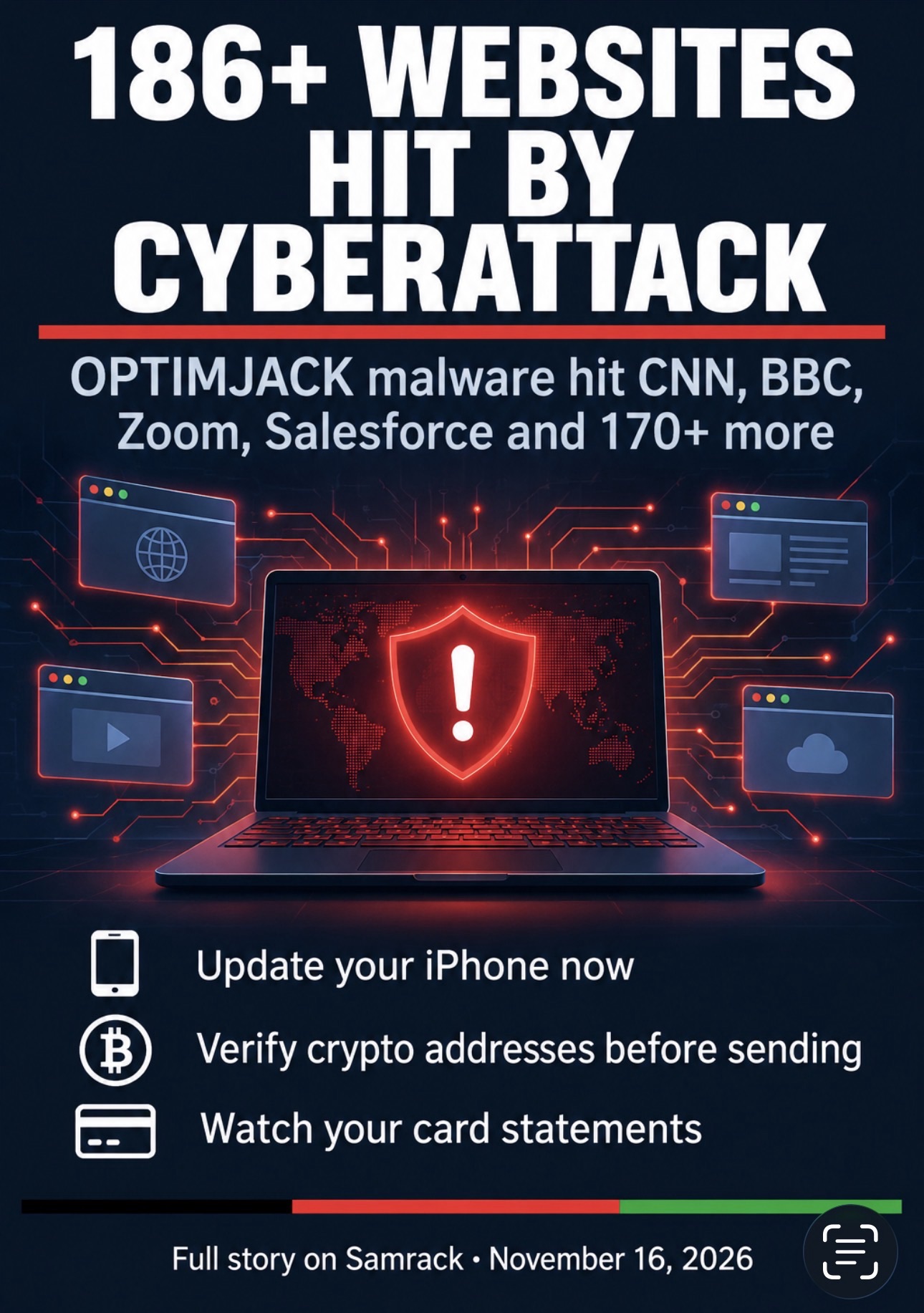
On Monday, November 16, 2026, some of the world’s most trusted websites — CNN, BBC, Zoom, Salesforce and more than 170 others — unknowingly served dangerous malware to millions of visitors. The attack, dubbed OPTIMJACK, did not break into these websites directly. It poisoned the trusted software they all share, turning the internet’s biggest brands into unwilling delivery vehicles for theft.
Here is what happened, who was hit, and the steps you should take today — especially if you trade crypto, shop online, or use an iPhone.
What Happened?
The attackers compromised Optimizely Web, a widely used A/B testing platform that thousands of major websites use to test page designs and run experiments (Cointelegraph).
They injected malicious JavaScript code into Optimizely’s customer-editable Project JavaScript field. Because the poisoned code was served from Optimizely’s own content delivery network — a trusted web address — the websites of roughly 178 organizations unknowingly passed it to every visitor (Breach History, aireport).
Security researcher Scott Helme, founder of the monitoring service Report URI, exposed the campaign after his team checked 1,611 Optimizely scripts and found 188 infected files belonging to 178 organizations. The “186+ websites” figure that spread across social media came from an earlier count in the same sweep (Cyber Kendra, StepSecurity). Researchers say the real number is likely higher, because they could only check scripts they already knew about (Breach History).
Who Was Affected?
The victim list reads like a cross-section of the global economy. Confirmed names include:
• News: BBC, CNN, Fox News, NPR
• Tech: Zoom, Salesforce, GitLab, Hootsuite, Smartsheet, Bitly
• Finance and banking: HSBC (several regions), Equifax, IG, Interactive Investor, TMS Brokers, OANDA/Coinpass
• Retail and airlines: IKEA, American Eagle, ASOS, Levi’s, Air France-KLM, Alaska Airlines, Hawaiian Airlines
• Other majors: Starbucks Canada, Vodafone Australia, Virgin Media O2, Change.org, UNICEF USA, Heineken, PokerStars, Lucid Motors — and even Optimizely’s own website
(Cyber Kendra, shiftdelete, aireport)
The attack ran for roughly 17 hours, with infections reported as early as 4:21 UTC on November 16 before cleanup was largely completed that evening (Cyber Kendra, piqmarkets).
What the Malware Could Do
OPTIMJACK was not a single trick — it was a multi-purpose theft kit, continuously updated by the attackers during the day (StepSecurity, TLDR):
- Crypto wallet swapping. When a visitor copied a cryptocurrency wallet address, the malware silently replaced it with an attacker-controlled address — targeting Bitcoin, Ethereum, Solana, TON, TRX, Litecoin, BCH and Dogecoin. Any funds sent to the swapped address went straight to the thieves, and such transfers cannot be reversed (infrastack, Cointelegraph).
- Card skimming. It captured card numbers, expiry dates and security codes entered into payment forms on affected sites (Cointelegraph).
- Data and cookie theft. It collected browser cookies, page information and screenshots from infected sessions (aireport).
- iPhone exploit delivery. On iPhones and iPads running iOS 18.6 or older, it loaded exploit kits that could compromise the device itself (infrastack).
Importantly, appearing on the affected list means a site’s Optimizely script was infected — it does not mean the site’s own servers were broken into (Cyber Kendra).
What You Should Do Now
If you visited any affected site on November 16, 2026:
• iPhone and iPad users: Update immediately to iOS 18.7.3 or later, or iOS 26.3 or later. These versions are patched against the exploit kits. Check your version under Settings > General > About (Cyber Kendra).
• Crypto users: If you copied and pasted a wallet address on any major website that day, compare it character by character before sending funds. Better still, confirm the address on a hardware wallet screen. One wrong character and your money is gone forever (Cyber Kendra).
• Online shoppers: If you entered card details on an affected site, monitor your statements closely for unfamiliar charges. Security firm StepSecurity advises treating the card as compromised and replacing it (Cyber Kendra).
• Everyone else: If you only read pages on a desktop browser, without handling wallet addresses or entering card details, the malware had little to take from you (Cyber Kendra). - For website owners and developers: Inspect every Optimizely project’s JavaScript for unknown code, the domain 1688360[.]cc , and suspicious atob( calls. Rotate all credentials with write access, review CSP protections, and check proxy logs from early November 16. Network teams should block the malicious domains listed in the Report URI and StepSecurity reports (Cyber Kendra).
The Bigger Lesson
OPTIMJACK is a textbook supply-chain attack: instead of breaking into 178 separate companies, the criminals compromised one shared supplier and let the trusted brand names do the delivery. For the diaspora community that relies on global platforms for remittances, trading and business, the lesson is simple — even a “big name” website can serve you poisoned code through no fault of its own.
As of this writing, Optimizely has not published a public statement, and researchers do not yet know how the attackers gained access or who was behind it (Cyber Kendra). We will keep you updated as the investigation unfolds.
Stay alert. Verify addresses. Update your devices.
Sources: Cointelegraph · Cyber Kendra · StepSecurity · Report URI via Breach History · UK News in Press