Speaking the Masters Language
There are words that come around each April, ones that stir the emotions, that make it feel like the Masters at Augusta National Golf Club is once again upon us. They are unique and special, elicit the warmth of spring, spark nostalgia and call out to history.
Here is the Ultimate Masters Glossary:
Amen Corner: The most famous stretch at Augusta National – the par-4 11th, the par-3 12th and the par-5 13th. The legendary Sports Illustrated writer Herbert Warren Wind coined the term in 1958.
Arnold Palmer Plaque: Palmer won the Masters Tournament in 1958, 1960, 1962 and 1964. In 1995, nine years before Palmer played in his final Masters, a plaque was dedicated to commemorate his play and his contributions to the Masters. The plaque is affixed to the fountain behind the 16th tee.
Augusta National Women’s Amateur: Announced by Chairman Fred S. Ridley in 2018 and first played the following year, the Augusta National Women’s Amateur takes place prior to the Masters. The best amateur women in the world compete and play the championship’s final round at Augusta National.
Azalea: Rhododendron specie. The name for the par-5 13th hole. The azalea is one of the plants most synonymous with Augusta National, thanks to its colorful bloom and presence throughout the grounds.
Big Oak Tree: The live oak stands outside the Clubhouse on the golf course side and serves as one of the Tournament’s most iconic gathering spots. It was planted in the 1850s, making it more than 170 years old.
Butler Cabin: The place every Masters competitor hopes to visit in the early evening on Sunday. Built in 1964, Butler Cabin is where the new champion is first awarded the Green Jacket by the previous year’s champion.
Camellia: Camellia japonica. The name of the par-4 10th hole, which begins the second nine. The Berckmans family, who ran a nursery on the property before the construction of Augusta National, imported camellias from Japan, France, Belgium and Germany.
Carolina Cherry: Prunus caroliniana. The name for the par-4 ninth hole. The Carolina Cherry is a small, native evergreen which bears prolific clusters of small, white flowers in April followed by black berries.
Champions Dinner: The gathering, on Tuesday of Masters week, welcomes all the past champions of the Tournament and is formally referred to as the Masters Club Dinner. The tradition began in 1952 when Ben Hogan invited all past champions to dine together. The previous year’s winner selects the menu.
Chinese Fir: Cunninghamia lanceolata. The name for the par-4 14th hole. The Chinese Fir is a unique evergreen that is prized in China and Japan, where it’s often used for lumber and woodworking.
Crow’s Nest: The 30-by-40 foot dormitory above the clubhouse that houses amateurs competing in the Masters Tournament. It is also the namesake of the signature beer (Crow’s Nest) which is served on the grounds.
Crystal: Prizes awarded to players who have the day’s low score (crystal vase), an eagle (pair of crystal glasses) and a hole-in-one or double eagle (large crystal bowl).
Cupola: The 11-by-11 foot structure that rises above the Clubhouse and has windows on all four sides. It is the highest point on the property and was often used by the Berckmans family in the early days as their main viewpoint of the nursery grounds.
Drive, Chip & Putt: Held annually since 2014, the national competition culminates with the National Finals at Augusta National. Age groups spanning from ages 7 to 15 years old compete in the three disciplines, finishing with two putts on No. 18 green.
Eisenhower Cabin: Just beside the practice putting green, the cabin was built by the Club for President and Mrs. Eisenhower in 1953. Eisenhower visited Augusta National 45 times before his death in 1969.
Firethorn: Pyracantha coccinea. The name for the pivotal par-5 15th hole. The firethorn belongs to the rose family, with the name coming from the multitude of thorns covering the branches.
First Nine: Beginning with the first hole and ending with the ninth, the stretch of golf that opens the Masters.
Flowering Crab Apple: Malus hybrida. The name for the par-3 fourth hole. The trees have light-pink to deep-rose flowers that are followed in the fall by tiny apples, a popular food for wild birds.
Flowering Peach: Prunus persica. The name for the par-4 third hole. These flowers come in white, pink, red or variegated colors.
Founders Circle: The round driveway that is between Magnolia Lane and the Clubhouse. At the base of the flagpole in front of the Clubhouse rests two plaques dedicated to Augusta National Golf Club and Masters Tournament co-Founders – Bobby Jones and Clifford Roberts.
Golden Bell: Forsythia intermedia. The name for the famous par-3 12th hole, with Rae’s Creek sitting in front of the green. The golden bell is one of the most popular flowering ornamentals in America.
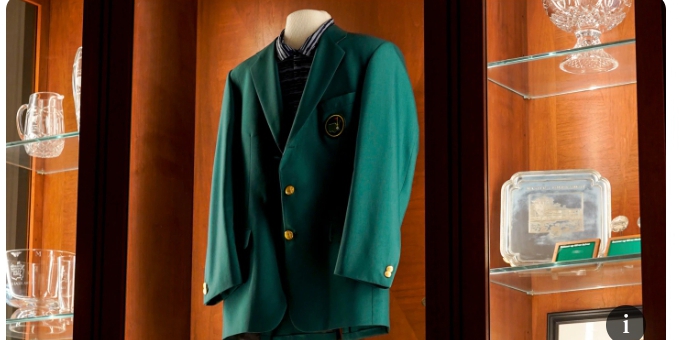
Green Jacket: Awarded to the winner of the Masters Tournament. Members began wearing the Green Jacket in 1937; it was first awarded to a champion in 1949 when Sam Snead won.
Hogan Bridge: This bridge takes the players over Rae’s Creek and to the 12th green. It was dedicated to Ben Hogan in 1958 to commemorate his record score of 274 in 1953.
Holly: Ilex opaca. The name for the par-4 18th hole. A staple around the holidays, there are several varieties of the holly on the finishing hole at Augusta National.
Honorary Starters: The designated players who open the Masters with an honorary tee shot. The tradition began in 1963 with Jock Hutchison and Fred McLeod. Jack Nicklaus, Gary Player and Tom Watson currently serve in the role.
Ike’s Pond: During his second visit to Augusta National, General Dwight D. Eisenhower walked through the woods on the eastern part of the Club’s property. Upon his return, he informed Clifford Roberts he had found the perfect place for a dam if the club ever wanted to have a fish pond. In 1949, the pond was built.
Jack Nicklaus Plaque: Nicklaus has won more Masters than any other player, claiming the Green Jacket six times. The plaque is affixed to the drinking fountain between Nos. 16 and 17.
Jumpsuit: The white uniforms worn by caddies at Augusta National.
Juniper: Juniperus virginiana. The name for the par-3 sixth hole. The Juniper has an aromatic wood that makes it popular for storage chests and other furniture. The trees are used extensively as Christmas trees in the Southern United States.
Loblolly pine: Pinus taeda. The predominant species of pine at Augusta National.
Magnolia: Magnolia grandiflora. The name for the par-4 fifth hole. Magnolia trees are massive evergreen trees with large, fragrant white flowers.
Magnolia Lane: The entryway to Augusta National. It is lined by large magnolia trees that date back to the 1850s. It was first paved in 1947 and is approximately 330 yards.
Main Scoreboard: Standing just to the right of the first fairway, the Main Scoreboard is different from the other leader boards around Augusta National because it has the scores of every player in the Masters Tournament. It also carries the home country flag of every participant.
Nelson Bridge: This bridge, dedicated in 1958, is at the 13th tee. It commemorates Byron Nelson’s birdie-eagle stretch at the 12th and 13th during his Masters win in 1937.
Nandina: Nandina domestica. The name for the par-4 17th hole. Nandina is sometimes called Heavenly Bamboo and often located near the doors of Japanese homes as a symbol of good luck.
Pampas: Cortaderia selloana. The name for the par-4 seventh hole. Native to Argentina, the pampas grass sends up its plume-like flowers in August, with the seed tassels lasting until the following spring.
Par 3 Contest: Held Wednesday of Tournament week, the Par 3 Contest takes place on the Par 3 course, which was originally designed in 1958 by architect George Cobb and Clifford Roberts. There have been 115 holes-in-one during the Par 3 Contest. No player has ever won the Masters Tournament and the Par 3 Contest in the same week.
Patron: Attendees of the Masters Tournament, known for their golf knowledge, style and etiquette.
Pimento Cheese Sandwich: One of the signature concessions served at the Masters Tournament, priced at $1.50.
Pink Dogwood: Cornus florida. The name for the par-5 second hole. The pink dogwood blooms from late March through April. No. 2 is flanked by these native trees.
Rae’s Creek: The body of water at the back of the 11th green, in front of 12th green and 13th tee. Named after John Rae, a settler in Augusta from 1734.
Redbud: Cercis candensis. The name for the par-3 16th hole. The redbud is a small tree native to the eastern United State and is commonly called the Judas tree.
Sarazen Bridge: The bridge that resides left of the 15th green and commemorates Gene Sarazen’s double-eagle 2 at the par 5 in 1935.
Second Nine: The stretch of holes from Nos. 10-18.
Tea Olive: Osmanthus fragrans. The name for the par-4 first hole. Tea olive is an evergreen ornamental or small tree that has intermittent displays of white flowers from December to March.
The Patch: Widely used nickname for Augusta Municipal Golf Course. Established in 1928 and reopening in 2026, The Patch was renovated by Masters Tournament Charities, the First Tee – Augusta and Augusta Technical College. It features a 18-hole course redesigned by Tom Fazio and Beau Welling and a 9-hole short course, The Loop at The Patch, designed by Tiger Woods.
Tournament Practice Area: The facility players use to prepare for the Masters Tournament. It opened in 2010.
Tributary: The small body of water along the fairway and in front of the green at No. 13 that flows into Rae’s Creek.
White Dogwood: Cornus florida. The name for the par-4 11th hole. The white dogwood blooms flowers in late March and early April.
Yellow Jasmine: Gelsemium sempervirens. The name for the par-5 eighth hole. The yellow jasmine is a twining vine native to the Southeast