Ruto Awards Kenya an A for Progress Under Vision 2030
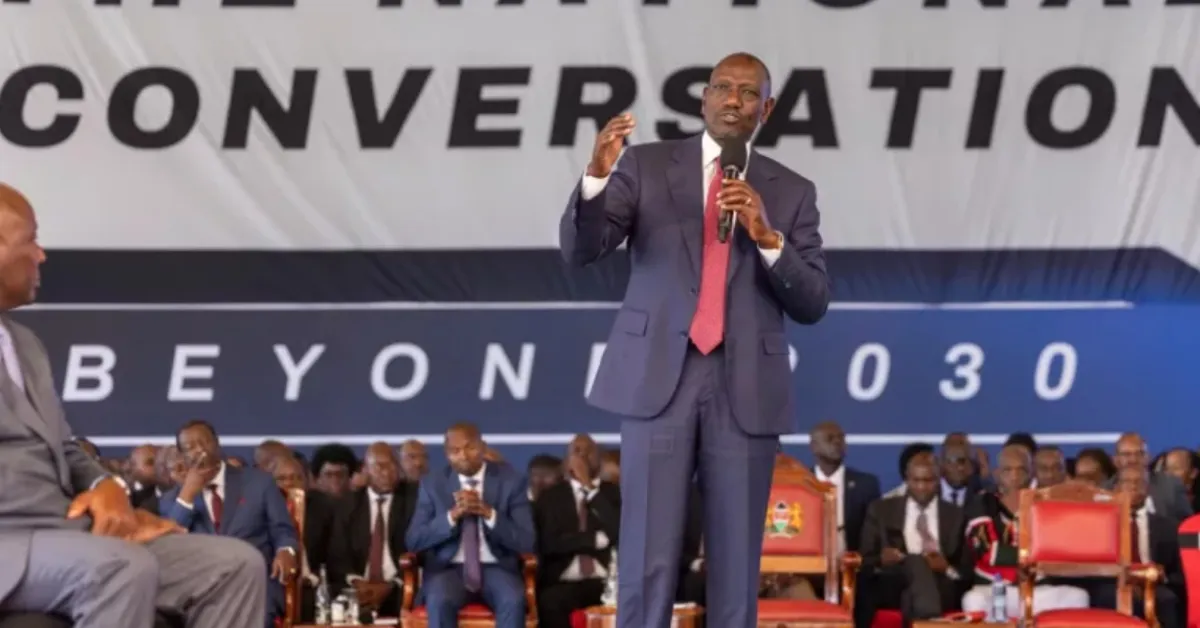
President William Ruto has called for a new national development compact to guide Kenya beyond 2030, saying technological disruption, artificial intelligence and climate change have changed the conditions under which the country’s existing long-term strategy was developed.
Speaking at the launch of the national conversation on Vision 2060 at the Kenyatta International Convention Centre on Wednesday, Ruto said the new framework should extend beyond individual presidencies and electoral cycles. He called on Kenyans across the country to help define the ambitions and priorities that should guide the next three decades.
Vision 2060 is expected to succeed Vision 2030, the development blueprint introduced in 2008 with the goal of making Kenya a prosperous, industrialised, middle-income country with a high quality of life and a secure environment. Ruto credited former President Mwai Kibaki and those who developed the original plan with providing an important foundation for national planning.
He said Kenya now operates in circumstances that are significantly different from those that existed when Vision 2030 was drafted. Climate change has become more pronounced, technology is advancing rapidly and artificial intelligence is beginning to reshape economies and labour markets. These developments, he said, make it difficult to rely indefinitely on a framework created almost two decades ago.
Ruto also pointed to the constitutional changes that followed the adoption of the 2010 Constitution. Vision 2030 was developed before the Constitution introduced a stronger system of public participation and devolved governance. He said this was important because a national development strategy must reflect citizens’ priorities to gain lasting legitimacy.
“Vision 2030 has provided a framework for us to figure out our development,” Ruto said, adding that the new process would provide an opportunity to develop a plan within the constitutional system now governing the country.
Ruto also presented the Government’s assessment of Vision 2030 as evidence of significant progress. On the political pillar, he said Kenya had achieved a score of more than 80 per cent, which he described as an “A”. He cited the 2010 Constitution, the Bill of Rights, the judiciary, civil society and democratic institutions as areas where the country had made substantial progress.
The new vision is expected to address economic transformation, industrialisation, employment, technology, infrastructure, energy, climate resilience and human capital. Treasury Cabinet Secretary John Mbadi said the exercise should not be associated with the current administration, arguing that a strategy extending to 2060 cannot belong to one president.
“Ruto has not developed a vision. Tomorrow we are starting conversation on how to develop vision for this country,” Mbadi said, stressing that public consultations should determine the substance of the final document.
The emphasis on public ownership comes as Kenya approaches the 2027 General Election. Ruto has called on political leaders, including those in the opposition, to contribute ideas while keeping the long-term planning process separate from partisan competition. The Government will face the challenge of ensuring that the process remains national and can withstand changes in administration.
The importance of public participation was highlighted during the launch by a young innovator presenting an initiative aimed at addressing Kenya’s brain drain. The presenter briefly lost his composure when a small plastic container being used during the demonstration fell onto the podium. Ruto smiled as the presentation continued.
The container was part of the Hack-Kenya@100 initiative, a network of young innovators seeking to encourage Kenyans to develop solutions locally rather than viewing migration as the main route to opportunity. The initiative covers areas including agriculture, energy, artificial intelligence, education, healthcare, mobility, manufacturing, infrastructure and the creative economy.
The initiative aims to collect practical proposals from Kenyans and preserve them as a record of the country’s ambitions as it approaches its centenary. Citizens are encouraged to propose solutions to national problems and assess, when Kenya reaches 100, whether those ambitions have been achieved.