Burkina Faso: The “Land of Upright People” at a Crossroads
Burkina Faso: The “Land of Upright People” at a Crossroads
Samrack | Africa Explained
Few African countries have been in the headlines as much as Burkina Faso in recent years. Its young military leader is a hero to many people across the continent and online. The country is also fighting a brutal insurgency, and its gold and cotton draw global interest. Here is what you need to know.
A name with a message
Until 1984 the country was called Upper Volta. Its current name, Burkina Faso, means “Land of Upright People” . It became independent from France on 5 August 1960 . Ouagadougou, known as “Ouaga,” is the capital and largest city .
Young, diverse and growing
About 24.7 million people live in Burkina Faso , and the median age is only about 17 . The Mossi make up roughly half the population, and more than 60 languages are spoken . In 2023 a constitutional change made national languages such as Mooré official and moved French to the role of a “working language,” a clear sign that the country wants to stand on its own .
Traoré and the break with France
Captain Ibrahim Traoré, now one of the world’s youngest heads of state, took power in a coup on 30 September 2022 . A 2024 charter extends military rule to mid-2029, and all political parties were dissolved in January 2026 . In June 2026 Burkina Faso cut diplomatic ties with France completely. It now works with Mali and Niger in the Alliance of Sahel States, which opened a joint parliament in Niamey this year .
Supporters praise his stand for African sovereignty. Critics point to the shrinking space for political parties and dissent.
Just opened: a homegrown tech academy
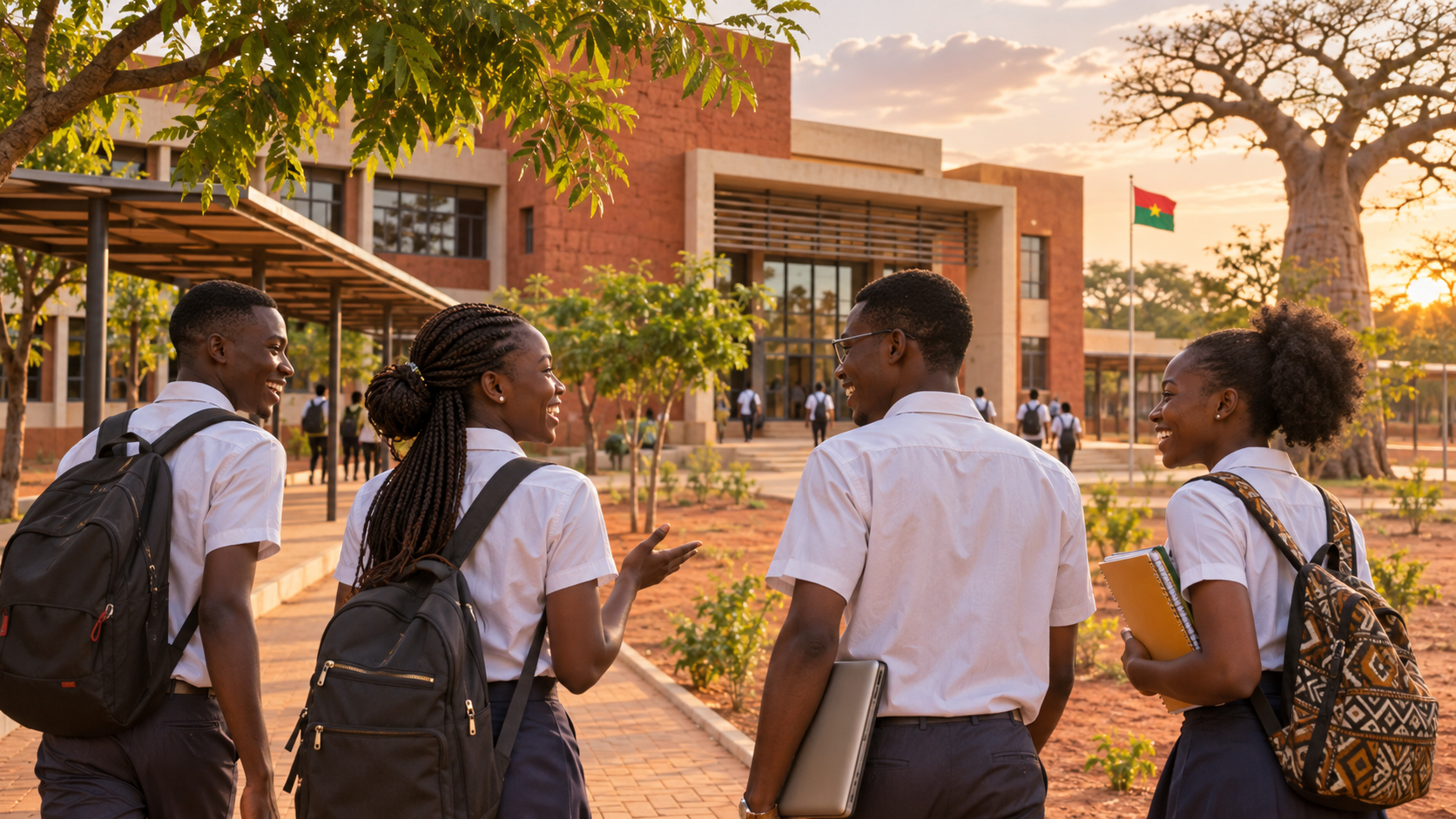
On Monday, 23 November 2026, President Traoré opened the Faso Technological Academy (Académie Technologique du Faso, or ATF) in Pabré, just north of Ouagadougou . The 60-hectare campus was built in about 11 months, using national funds and local workers. The first phase cost about 37.37 billion CFA francs, roughly €57 million .
The academy is welcoming its first class of 250 students, chosen from the top 2026 secondary-school graduates in science and technical streams. All of them will board on campus . Students begin with a two-year preparatory program and then specialise in strategic fields such as mining, metallurgy, nuclear science and aeronautics . Places are also set aside for top graduates from Mali and Niger, the country’s partners in the Alliance of Sahel States .
Not everything is ready yet: Traoré said the expensive laboratory equipment will be installed in stages . For many young Burkinabè, though, the message is clear. They can now train as engineers at home instead of going abroad.
A country at war
Away from the politics, Burkina Faso is fighting armed groups linked to al-Qaeda and the Islamic State. The 2026 Global Terrorism Index ranked it 2nd in the world for the impact of terrorism. About 4.5 million people need humanitarian aid .
Gold, cotton and hard realities
Gold drives the economy. GDP reached about US$27.6 billion in 2025, with growth of about 5.3% . Burkina Faso is also one of West Africa’s largest cotton producers . Most people have not yet shared in that wealth: the country ranks 186th on the UN Human Development Index , life expectancy is about 61 years, and adult literacy is about 42% .
Africa’s film capital
Burkina Faso is also a cultural powerhouse. Ouagadougou hosts FESPACO, Africa’s largest film festival, which brings filmmakers from across the continent and the diaspora .
Why it matters to us
For Kenyans at home and abroad, Burkina Faso’s story raises questions many African nations face: Who controls our resources? How do we balance security and freedom? What does true independence look like more than 60 years after the flags changed?