Who Really Appointed Pamela Mboya? Setting the Record Straight on a Persistent Myth
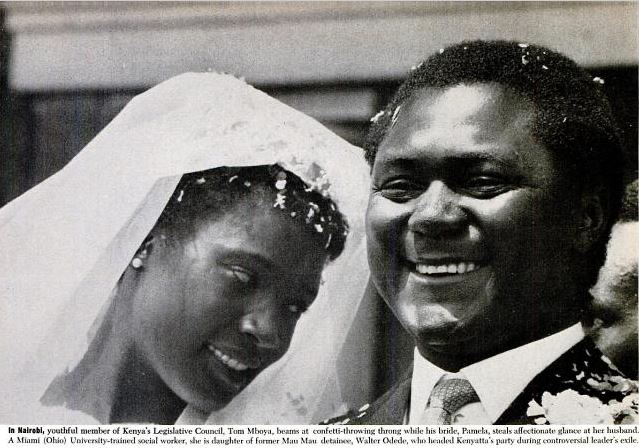
A claim has been circulating that President Jomo Kenyatta rewarded Pamela Mboya with a United Nations posting immediately after orchestrating the 1969 assassination of her husband, Tom Mboya. This narrative blends grief, suspicion, and politics but it collapses when you line it up against the historical timeline.
The Assassination of Tom Mboya
Tom Mboya, then Kenya’s Minister for Economic Planning and Development, was shot dead on 5 July 1969 in central Nairobi as he left Chhani’s Pharmacy on Government Road (now Moi Avenue). His killing shocked the nation and immediately fueled speculation that powerful political interests wanted him eliminated. A man named Nahashon Isaac Njenga Njoroge was arrested, tried, convicted, and later hanged for the murder, though his cryptic question “Why don’t you go after the big man?” kept conspiracy theories alive.
What People Are Claiming
In today’s heated online debates, some commentators assert that Pamela Mboya was quickly appointed as Kenya’s Permanent Representative to the United Nations as a form of “blood money” or compensation engineered by Jomo Kenyatta. Social media posts frame this as part of a pattern: that widows of slain political figures are later “rewarded” with diplomatic roles, and that the UNEP or UN ambassadorial post is the standard landing place after political elimination. This framing implies two things that Pamela’s appointment was immediate and that Kenyatta personally handled it as part of a cover‑up.
The Actual Timeline of Pamela Mboya’s Appointment
Official records from Kenya’s Permanent Mission to UN‑Habitat and UNEP show a very different story. The list of Kenya’s Permanent Representatives indicates that Margaret Kenyatta held the post from 1976 to 1986, while Pamela Mboya served much later, from 1986 to 1997. That means Pamela assumed the UNEP/UN‑Habitat role roughly 17 years after Tom Mboya’s assassination, not in 1969 or the early 1970s.
This timing matters politically because Jomo Kenyatta died in 1978; Daniel arap Moi then became president and consolidated power through the 1980s. Pamela’s appointment in 1986 therefore fell squarely under President Moi’s administration, almost two decades after her husband’s death.
Why the Kenyatta-Appointment Story Is Misleading
The claim that Kenyatta “appointed Pamela after killing her husband” misleads on at least three levels:
• It ignores dates. Tom Mboya was killed in 1969, Margaret Kenyatta held the UN‑Habitat/UNEP role from 1976–1986, and Pamela Mboya only took over from 1986.
• It misattributes presidential power. By the time Pamela became Permanent Representative, Moi not Kenyatta was president and the key decision‑maker on such appointments.
• It conflates different UN roles. Some posts describe her vaguely as “UN Ambassador,” which helps the myth along, but the official record is specific: she was Kenya’s Permanent Representative to UNEP/UN‑Habitat based in Nairobi, not a New York‑based UN Ambassador immediately after 1969.
In short, while grief and suspicion around Tom Mboya’s death are understandable, tying Pamela’s 1986 diplomatic posting directly to Kenyatta as a post‑assassination payoff is historically inaccurate.
Lessons for Today’s Debates
The controversy around Ida Odinga’s recent nomination as Permanent Representative to UNEP has revived old comparisons with Pamela Mboya’s story. Commenters argue that the state “always” uses this UNEP seat to appease widows and allies, citing Tom Mboya’s widow as the original example. Yet once the dates and presidencies are laid out, the pattern is less sinister and more about how high‑profile diplomatic posts become symbols in domestic political battles.
For a news blog, the key is to separate emotion from evidence: Tom Mboya’s assassination remains a painful and contested chapter, but the record is clear that Pamela Mboya’s UNEP/UN‑Habitat appointment was a Moi‑era decision made nearly twenty years later not an immediate reward orchestrated by Jomo Kenyatta in 1969.