Senior Govt Officials Put on Notice Over Fake Academic Certificates
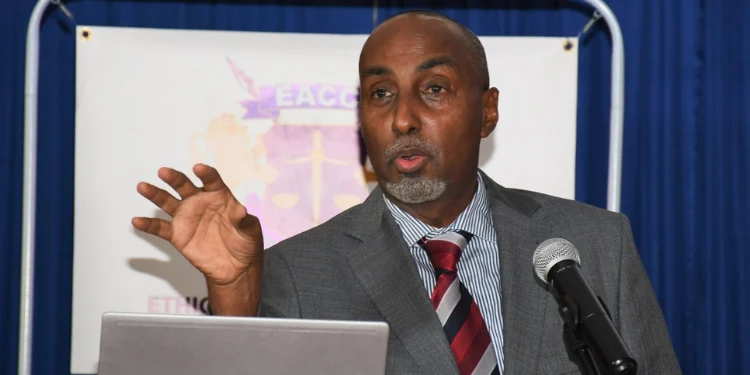
The Ethics and Anti-Corruption Commission (EACC) has raised concerns over the growing use of fake academic certificates in Kenya.
According to EACC Chairperson Dr. David Oginde, even senior government officials have been found using forged documents, an issue he described as a national embarrassment.
He highlighted that Kenya has enough accredited universities to meet the needs of anyone seeking genuine qualifications and urged public officials to uphold integrity rather than resort to shortcuts.
“It is very sad that even very senior people in government are operating under false documents, forged certificates. It is an embarrassment to our society. If you want academic qualifications, we have more than enough universities in this country, and you can go there at any time, “said David, Chairman of EACC
EACC’s Report on the Use of Fake Academic Certificates
The commission has stated that investigations revealed senior government officials are operating with falsified academic documents, threatening the credibility of Kenya’s governance.
Dr. Oginde added that Kenya must reject a culture of shortcuts, especially in academic and professional advancement.
He stressed that integrity is crucial at every stage of the country’s development pipeline, warning that allowing forged credentials to thrive weakens national competitiveness.
“Kenya must never become a society where shortcuts supersede merit. Integrity must be upheld across every stage of our national development pipeline,” said Oginge
The EACC Chairperson encouraged individuals without formal education to pursue legitimate learning opportunities rather than forge certificates.
He gave an example of a 92-year-old Kenyan who recently decided to sit for KCSE, noting that it is never too late to return to school.
“If you want academic qualifications, we have more than enough universities in this country, and you can go there at any time. It is never too late, so let’s not take shortcuts,” he added.
However, the Commission recommended that public entities submit a list of all shortlisted candidates for integrity verification.
In addition, they must verify the academic certificates and professional qualifications of all applicants and shortlisted candidates.
Other Key Highlights Discussed in the Report
The EACC report outlined a comprehensive set of activities, including law enforcement, corruption prevention, promotion of ethical practices, and the establishment of strategic partnerships for the Financial Year 2024/2025.
In law enforcement, the commission revealed that it had processed 4,183 reports, of which 1,846 were deemed relevant for investigation. The most common allegations were bribery and embezzlement of public funds.
The Commission supported the formulation of the Anti-Corruption Laws (Amendment) Bill, 2025, aiming to ensure that corruption cases and appeals are concluded within six months, enhance the DPP’s accountability for submitted files, and debar convicted persons from participating in tenders for 10 years.
Also, the Commission partnered with national and international organizations, including the European Union/UNODC, the Federal Bureau of Investigation (FBI), and the Kingdom of Saudi Arabia, to enhance capacity and technical support.
The EACC initiated measures, in partnership with the National Treasury, to embed anti-corruption frameworks within climate action systems, focusing on monitoring and promoting ethics in the management of climate action resources at the County level.